
The PostgreSQL protocol runs one query at a time per connection. That is why pools and poolers exist: to run a hundred queries in parallel you need a hundred connections, and once the pool is full every new request waits.
The waiting is the expensive part. If a client is 100 ms from the pooler and the pooler is 1 ms from the database, each pooled connection spends almost all of its time idle, holding a slot until the round trip ends. Push to a thousand TCP connections and you start hitting “too many open files” before the database is even busy.
The idea
Don’t change Postgres; change what carries it. I modified the pgcat pooler to accept QUIC, where one connection carries many independent streams. Each client query session becomes a stream, so fifty connections can do the work of five hundred, and a slow stream never stalls its neighbours.
  TCP + TLS 1.3                      QUIC
  client          server             client          server
    |---- SYN ------->|                |-- Initial ----->|
    |<--- SYN/ACK ----|                |<- Handshake ----|  1 RTT
    |---- ClientHello>|                |-- query ------->|
    |<--- ServerHello-|  2 RTT
    |---- query ----->|
Figure 1: Round trips before the first query
The result
The benchmark ran 500 TCP connections against 50 QUIC connections with
40 streams each, using the settings in the repo’s .env.tcp and
.env.quic.
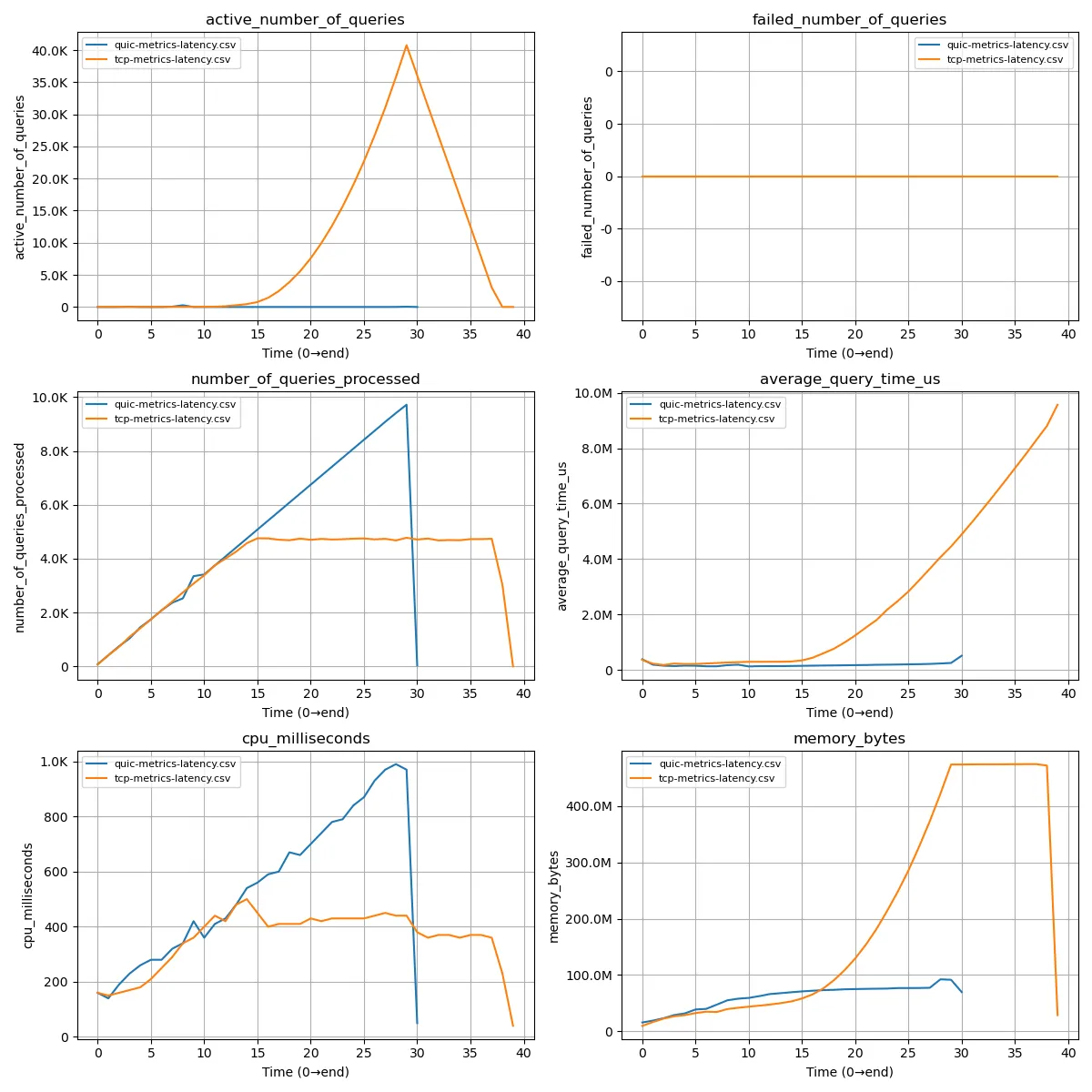
- Queries pile up on TCP. Its backlog of active queries climbs to about 40,000 while QUIC’s stays near zero.
- Latency stays flat on QUIC. TCP’s average query time rises steadily to around 9.5 seconds as the backlog grows.
- About twice the work. QUIC processed close to 10,000 queries while TCP plateaued under 5,000.
- A fraction of the memory. TCP peaked near 480 MB against roughly 90 MB for QUIC.
- More CPU on QUIC, which is expected: it was doing twice the work, in user space.
What actually wins
Most of the gain is multiplexing, not QUIC itself. HTTP/2-style streams over TCP would remove much of the same waiting. QUIC earns its place with two properties that suit a pooler:
- No head-of-line blocking. On TCP a lost packet freezes every stream on the connection; on QUIC it only delays the stream it hit.
- 0-RTT resumption. A pool closes and reopens connections all the time, and QUIC can resume one without a fresh handshake.
The cleanest fix would be a multiplexed Postgres protocol, but how Postgres manages connections is tied deep into its architecture. A pooler that speaks QUIC on one side and plain Postgres on the other is the version that can ship today.